Free Kibbe Body Type Test
Kibbe Body Type Test
This Kibbe body type test estimates your Kibbe type based on questions about bone structure, flesh distribution, and facial features rather than measurements alone. Explore the 13 Kibbe types and get a general starting point for understanding Kibbe style concepts. Works for men and women.
Kibbe Body Type Test
Answer questions about your bone structure, flesh, and facial features to find your Kibbe type.
What Is Kibbe?
What Is the Kibbe Body Type System?
The Kibbe body type system was created by David Kibbe and popularized through his book "Metamorphosis." Unlike standard body shape categories such as hourglass, pear, and apple, the Kibbe system considers the overall combination of bone structure, flesh distribution, and facial features when describing style types.
Bone Structure
Kibbe looks at the sharpness or bluntness of your bones — angular vs rounded shoulders, narrow vs wide frame, sharp vs soft facial features. This is the primary factor in Kibbe typing.
Flesh Distribution
How flesh sits on your frame — muscular vs soft, taut vs rounded. This modifies your Kibbe type. Yin (soft, rounded) versus Yang (sharp, angular) flesh affects which variation of your type you are.
Facial Features
Sharp angular features vs rounded soft features contribute to the overall Yin-Yang balance. Kibbe considers the whole person — face included — not just the body.
Take the Test
Kibbe Body Type Test — Find Your Type
Answer these questions honestly based on your natural bone structure and features — not how you dress or style yourself.
Question 1 of 6 — Bone Structure
How would you describe your overall frame and bone structure?
Question 1 of 6
All Kibbe Types
The 13 Kibbe Body Types Explained
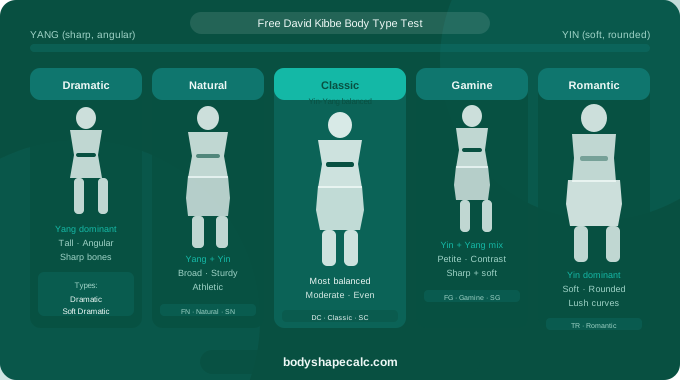
David Kibbe's system has 5 main families with variations — 13 types total. Each has its own style essence and most flattering lines.
Dramatic Family (Yang dominant)
Dramatic — Tall, angular, sharp bones. Long lines, minimal detail, sleek silhouettes.
Soft Dramatic — Dramatic frame with lush, curved flesh. Dramatic structure softened by curves.
Natural Family (Yang with Yin blend)
Flamboyant Natural — Tall, broad, athletic. Loose relaxed lines, natural fabrics.
Natural — Moderate, sturdy frame. Easy, unconstructed clothing.
Soft Natural — Natural frame with softer, rounder flesh. Relaxed but with gentle curves.
Classic Family (Yin-Yang balanced)
Dramatic Classic — Balanced proportions with slight Yang sharpness.
Classic — Perfectly balanced, moderate in everything. Tailored, symmetrical styles.
Soft Classic — Balanced frame with softer, rounder features. Classic with gentle curves.
Gamine Family (Yin-Yang contrast)
Flamboyant Gamine — Small frame, sharp angular features. Bold, geometric, high contrast.
Gamine — Small, delicate frame with mix of sharp and soft. Playful, quirky styles.
Soft Gamine — Small frame, mostly rounded soft features. Cute, youthful, feminine.
Romantic Family (Yin dominant)
Theatrical Romantic — Romantic body with some sharpness in features. Lush curves with slightly bolder detail.
Romantic — Small, rounded, lush curves throughout. Soft, delicate, feminine styles.
Kibbe vs Standard Body Shape
Kibbe types are different from standard body shapes (hourglass, pear, apple). Kibbe looks at the whole person — bone structure, flesh, and face. Standard body shapes only look at bust, waist, and hip measurements. Both systems are useful for different styling purposes.
How It Works
How Does the Kibbe Body Type Test Work?
The Kibbe body type test asks questions about your bone structure, flesh quality, and facial features to determine your Yin-Yang balance and identify your Kibbe type.
Step 1 — Assess bone structure
The test first looks at your overall frame — tall or petite, angular or rounded, narrow or broad. This is the most important factor in Kibbe typing. Bone structure determines your primary Kibbe family: Dramatic, Natural, Classic, Gamine, or Romantic.
Step 2 — Assess flesh and waist
Next the test looks at how flesh sits on your frame — taut and muscular (Yang), soft and lush (Yin), or moderate. Your waist definition and hip shape further refine which variation within your family you are — for example Soft Dramatic vs Dramatic.
Step 3 — Assess facial features
Finally the test looks at your facial features — sharp and angular vs rounded and soft. Faces contribute to the overall Yin-Yang balance and can push you toward a soft or flamboyant variation of your type.
Kibbe vs Measurements
Kibbe Body Type Test With Measurements — Does It Use Measurements?
Unlike standard body shape calculators, the Kibbe system does not primarily use bust, waist, and hip measurements. Here is what Kibbe uses instead.
Kibbe does not use measurements
The original David Kibbe system does not use tape measure numbers for typing. Kibbe explicitly states that measurements are not reliable indicators of Kibbe type because the same measurements can belong to very different Kibbe types depending on how they are carried — bone structure and flesh quality matter more than the numbers themselves.
What Kibbe uses instead
Kibbe typing uses: overall frame size and bone structure (Yang vs Yin), shoulder shape (sharp/angular vs sloped/rounded), waist and hip shape, flesh texture (taut vs lush), and facial bone structure and features. These qualitative factors determine Kibbe type more accurately than measurements alone.
Men and Plus Size
Kibbe Body Type Test for Men and Plus Size
Kibbe body type test for men
The Kibbe system was originally developed for women but applies to men too. For men, the same bone structure and flesh principles apply. Men with sharp angular frames tend toward Dramatic or Natural families. Men with softer rounded features tend toward Classic or Romantic families. Take the test above — the questions apply equally to male body types.
Kibbe body type test plus size
Kibbe types apply at every size. Kibbe explicitly designed the system to be size-inclusive — your Kibbe type is determined by your bone structure and the quality of your flesh, not your size or weight. A plus size person can be any Kibbe type. The test above applies regardless of size.
Popular Kibbe Types
Popular Kibbe Body Types
Here are several Kibbe types and their commonly described characteristics.
Soft Classic Kibbe type
Soft Classic has balanced, moderate proportions with a slight Yin softness in flesh or features. Moderate height, even frame, slightly rounded features. Best styles: soft tailoring, draped fabrics, gentle structure. Neither too sharp nor too soft.
Theatrical Romantic Kibbe type
Theatrical Romantic has the lush Romantic body but with some Yang sharpness — usually in the facial features. Small, curved, petite frame with more defined features. Best styles: romantic softness with bolder detail and some structured elements.
Soft Dramatic Kibbe type
Soft Dramatic has the tall, angular Dramatic frame but with lush, curved flesh. The combination creates a dramatic silhouette with sensuous curves. Best styles: bold, dramatic silhouettes in luxurious, flowing fabrics.
Soft Natural Kibbe type
Soft Natural has the broad, sturdy Natural frame with softer, more rounded flesh. Relaxed Yang structure with Yin softness. Best styles: easy, relaxed clothing with gentle curves — soft wrap styles and flowing fabrics.
Flamboyant Natural Kibbe type
Flamboyant Natural is tall, broad, and athletic with an expansive, unconstructed quality. Strong Yang throughout. Best styles: loose, flowing, natural fabrics — relaxed and easy with no fussy detail.
Gamine Kibbe type
Gamine has a small, petite frame with a mix of Yang sharpness and Yin delicacy — a playful contrast. Best styles: geometric, bold, high contrast — mix of sharp and soft pieces in short, playful silhouettes.
Kibbe vs Other Systems
Kibbe Body Type Test vs Other Body Type Systems
The Kibbe system is one of several body type classification systems. Here is how it compares.
Kibbe vs standard body shapes
Standard body shapes (hourglass, pear, apple, rectangle) are based purely on the ratio between bust, waist, and hip measurements. Kibbe considers the whole person — bone structure, flesh, face, and overall Yin-Yang balance. You can be a pear body shape and a Soft Natural Kibbe type, or an hourglass and a Romantic. The two systems are compatible and complementary.
Kibbe vs body type quiz
A standard body shape quiz identifies hourglass, pear, apple, rectangle — based on proportional questions about your figure. The Kibbe test goes deeper — looking at bone quality, flesh texture, and facial structure. Both are useful. The standard quiz is simpler and faster. The Kibbe test is more detailed and gives more nuanced style guidance.
Related Tools
More Body Type Tools
Body Shape Calculator
Find your standard body shape from measurements — hourglass, pear, apple, rectangle, inverted triangle.
Body Shape Quiz
Quick 5-question quiz to find your body shape without a tape measure.
Body Type Calculator
Find your ectomorph, mesomorph, or endomorph body type from height, weight, and measurements.
Body Shapes for Women
Complete guide to all 7 female body shapes with measurements and style tips.
How to Dress for Your Body Type
Complete style guide for every body shape — women, men, plus size.
Different Body Types for Women
Overview of all female body types with best jeans, necklines, and swimwear for each.
FAQ
Kibbe Body Type Test — FAQs
What is the Kibbe body type system?
The Kibbe body type system was created by stylist David Kibbe in 1987. It classifies people into 13 body types based on the overall combination of bone structure (Yang vs Yin), flesh distribution, and facial features. The system goes beyond simple measurements to identify a person's natural style essence.
How many Kibbe body types are there?
There are 13 Kibbe body types across 5 families: Dramatic, Soft Dramatic, Flamboyant Natural, Natural, Soft Natural, Dramatic Classic, Classic, Soft Classic, Flamboyant Gamine, Gamine, Soft Gamine, Theatrical Romantic, and Romantic.
What is the difference between Kibbe types and body shapes?
Standard body shapes (hourglass, pear, apple, rectangle) are based purely on bust, waist, and hip measurements. Kibbe types consider the whole person — bone structure, flesh quality, facial features, and overall Yin-Yang balance. Kibbe is more holistic and focuses on style essence rather than proportion ratios.
What is Yin and Yang in Kibbe?
In Kibbe, Yang refers to sharp, angular, dramatic features — defined bones, taut flesh, angular face. Yin refers to soft, rounded, delicate features — rounded bones, lush flesh, rounded face. Most people have a mix of both. Your Kibbe type depends on which dominates and how they combine.
Is Kibbe body type the same as my body shape?
No. You can be a pear body shape and a Soft Natural Kibbe type, or an hourglass and a Romantic, or a rectangle and a Dramatic. The two systems measure different things. Kibbe focuses on the quality and structure of your body; standard body shape focuses on the proportional ratios between measurements.
How accurate is an online Kibbe test?
Online Kibbe tests are estimates. True Kibbe typing is best done by seeing a trained stylist or by carefully studying the full Kibbe system. Many people find themselves between types or find that their result changes as they learn more about the system. Use this test as a starting point for exploring Kibbe types.
Does the Kibbe test use measurements?
No — the original David Kibbe system does not primarily use tape measure numbers. Kibbe explicitly states that measurements are not reliable for typing because the same numbers can belong to very different Kibbe types. The system looks at bone structure, flesh quality, and facial features instead.
Can men take the Kibbe body type test?
Yes — the Kibbe system applies to men. The same bone structure and flesh principles work for male body types. Men with sharp angular frames tend toward Dramatic or Natural. Men with softer rounded features tend toward Classic or Romantic families.
Does Kibbe apply to plus size people?
Yes — Kibbe was designed to be size-inclusive. Your Kibbe type is determined by bone structure and flesh quality, not size or weight. A plus size person can be any of the 13 Kibbe types. The test applies regardless of size.
What is the most common Kibbe type?
There is no single Kibbe type that can be reliably identified as the most common. Kibbe typing depends on the characteristics and combination of features described by the system, and online tests provide only estimates.
What is the Kibbe body type test with pictures?
Some Kibbe tests include pictures of body types or facial features to help you identify which description matches your appearance. This test uses written descriptions for each answer. For picture-based Kibbe references, David Kibbe's book "Metamorphosis" is the original source with detailed visual examples.