Waist to Hip Ratio Calculator
Waist to Hip Ratio Calculator
Calculate your waist-to-hip ratio (WHR) from your waist and hip measurements. Enter your measurements in inches or centimeters to get your WHR and compare it with general reference ranges for men and women.
Waist to Hip Ratio Calculator
Enter your waist and hip measurements to calculate your waist-to-hip ratio instantly.
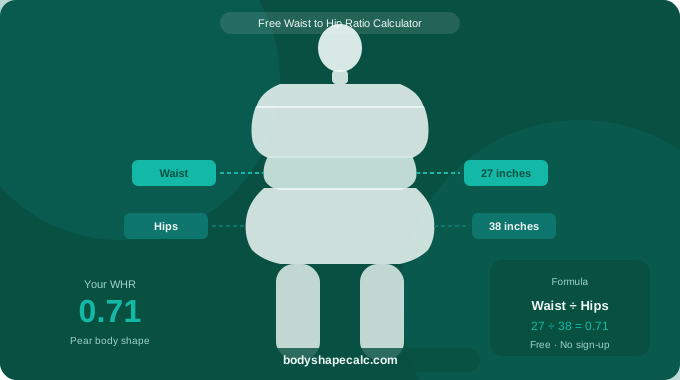
What Is Waist to Hip Ratio?
How to Calculate Waist to Hip Ratio
Your waist-to-hip ratio (WHR) is calculated by dividing your waist measurement by your hip measurement. It provides a simple comparison of waist and hip proportions and is commonly used in body-proportion and health-related assessments.
Step 1 — Measure your waist
Using a soft measuring tape, measure around the narrowest part of your natural waist — usually about 1 inch above your belly button. Stand relaxed and breathe normally. Do not suck in.
Step 2 — Measure your hips
Measure around the fullest part of your hips and seat — usually 7–9 inches below your natural waist. Keep your feet together and the tape level all the way around.
Step 3 — Calculate your WHR
Enter both measurements into the calculator above. Use the same unit for both (inches or cm). The calculator divides your waist by your hips to give your WHR and matches it to a general category.
WHR Formula
Waist to Hip Ratio Formula
The waist-to-hip ratio formula is straightforward. You only need two measurements — waist and hip — and both must use the same unit.
WHR Formula
WHR = Waist ÷ Hips
Divide your waist measurement by your hip measurement. The result is your waist-to-hip ratio — a number typically between 0.60 and 1.10.
Example in Inches
Waist = 30 inches, Hips = 40 inches
WHR = 30 ÷ 40 = 0.75
A WHR of 0.75 represents a relatively lower waist-to-hip ratio. The interpretation of WHR ranges can vary by guideline, population, age, and context.
Example in Centimeters
Waist = 76 cm, Hips = 100 cm
WHR = 76 ÷ 100 = 0.76
The unit does not affect the result — inches and cm give the same WHR for the same proportions.
WHR Chart
Waist to Hip Ratio Chart for Men and Women
These are general informational WHR ranges used for reference. Thresholds can vary by guideline, population, age, and context, so they should not be treated as universal cutoffs or a medical diagnosis.
Waist to Hip Ratio Chart — Women
Below 0.80 — Lower WHR range
0.80 to 0.84 — Moderate WHR range
0.85 and above — Higher WHR range
These ranges are general reference categories and should not be treated as an ideal body proportion or a diagnosis. WHR alone does not determine a person's body shape.
Waist to Hip Ratio Chart — Men
Below 0.90 — Lower WHR range
0.90 to 0.99 — Moderate WHR range
1.00 and above — Higher WHR range
These ranges are general reference categories and should not be treated as an ideal body proportion or a diagnosis. WHR alone does not determine a person's body shape.
⚠️ Important Note
Waist-to-hip ratio is a general body proportion measure used for informational purposes only. Health implications can vary significantly by age, ethnicity, body composition, fitness level, and individual context. If you have any health concerns related to your body composition, please speak with a qualified healthcare professional.
What Does My WHR Mean?
Common WHR Values Explained
Here are examples of specific waist-to-hip ratio values and what the numbers represent. These examples are for general reference and do not define a specific body shape or health status.
WHR 0.65 — What Does It Mean?
A WHR of 0.65 means the waist measurement is 65% of the hip measurement. This is a relatively low waist-to-hip ratio. WHR alone does not determine a specific body-shape category. Example: Waist 26", Hips 40" = WHR 0.65.
WHR 0.70 — What Does It Mean?
A WHR of 0.70 means the waist measurement is 70% of the hip measurement. It is a commonly referenced example when discussing waist-to-hip proportions, but there is no single WHR that defines an ideal or specific body shape. Example: Waist 28", Hips 40" = WHR 0.70.
WHR 0.75 — What Does It Mean?
A WHR of 0.75 means the waist measurement is 75% of the hip measurement. This represents a relatively lower waist-to-hip ratio, but WHR alone cannot identify a specific body-shape category. Example: Waist 30", Hips 40" = WHR 0.75.
WHR 0.80 — What Does It Mean?
A WHR of 0.80 means the waist measurement is 80% of the hip measurement. This provides a simple reference for comparing waist and hip proportions, but body-shape classification depends on additional measurements and the system being used. Example: Waist 32", Hips 40" = WHR 0.80.
WHR 0.85 — What Does It Mean?
A WHR of 0.85 means the waist measurement is 85% of the hip measurement. It represents a higher waist-to-hip ratio than the examples above, but WHR alone does not determine whether someone has an apple, rectangle, or another body shape. Example: Waist 34", Hips 40" = WHR 0.85.
WHR 0.90 — What Does It Mean?
A WHR of 0.90 means the waist measurement is 90% of the hip measurement. The same ratio can have different interpretations depending on the person's sex, age, population, and the guideline being used. Example: Waist 36", Hips 40" = WHR 0.90.
WHR and Body Shape
Waist to Hip Ratio and Body Shape
Waist-to-hip ratio describes the relationship between your waist and hip measurements. It can provide one indication of body proportions, but WHR alone does not determine a specific body-shape category. Body-shape systems may also consider bust, shoulders, high hip, and other measurements.
Hourglass Body Shape
Hourglass descriptions generally refer to relatively balanced bust and hip proportions with a noticeably smaller waist. WHR can describe part of this proportion, but it does not define an hourglass shape by itself.
Pear Body Shape
Pear descriptions generally refer to hips that are wider than the bust or upper body. A lower WHR may occur with these proportions, but WHR alone cannot determine whether someone has a pear body shape.
Apple Body Shape
Apple body-shape descriptions generally refer to relatively fuller proportions around the midsection compared with the hips. A higher WHR may occur with these proportions, but WHR alone cannot determine an apple body shape.
Rectangle Body Shape
Rectangle descriptions generally refer to relatively similar bust, waist, and hip measurements with less pronounced waist definition. WHR can describe part of these proportions, but it does not define a rectangle body shape by itself.
Measurement Guide
How to Measure Waist and Hip for WHR
Consistent measurements help you calculate WHR more reliably. Use a soft measuring tape and follow these guidelines.
How to Measure Your Waist
Stand relaxed and measure around your natural waist using a consistent measurement point. Keep the tape level and comfortably snug, without compressing the skin. Breathe normally and do not pull in your stomach.
How to Measure Your Hips
Stand with your feet together and measure around the fullest part of your hips and seat. Keep the tape level and parallel to the floor all the way around your body.
Waist vs High Hip vs Hips
For WHR, use your natural waist and your full hip measurement. Do not confuse the hip measurement with the high hip measurement — they are taken at different points on the body.
Inches or Centimeters?
You can use either inches or centimeters for this calculator. The WHR result will be the same because it is a ratio. Just make sure both your waist and hip measurements use the same unit.
WHR vs BMI
Waist to Hip Ratio vs BMI — What Is the Difference?
WHR and BMI are different measurements that use different inputs. WHR compares waist and hip measurements, while BMI uses height and weight, so they provide different types of information.
Waist to Hip Ratio (WHR)
WHR uses waist and hip measurements to describe the relationship between these two measurements. It does not require height or weight and should not be interpreted on its own as a measure of overall health or body composition.
Body Mass Index (BMI)
BMI is calculated from height and weight and is commonly used as a screening measure related to weight status. It does not show where body fat is distributed, and people with the same BMI can have different body proportions and WHR results.
Related Calculators
More Free Body Measurement Tools
Body Shape Calculator
Find your body shape from bust, waist, high hip, hip, and optional shoulder measurements. Identifies hourglass, pear, apple, rectangle, spoon, and inverted triangle.
Body Type Calculator
Estimate your body type using height, weight, chest or bust, waist, hips, and optional shoulder measurements.
Body Measurement Calculator
Understand what your bust, waist, and hip measurements mean and how they relate to your body shape and clothing size.
Dress Size Calculator
Estimate your dress size from body measurements. Covers UK, US, EU, and international size conversions.
FAQ
Waist to Hip Ratio Calculator – Frequently Asked Questions
Common questions about waist-to-hip ratio, the WHR formula, and how to use this calculator.
What does a WHR of 0.65 mean?
A WHR of 0.65 means your waist is 65% of your hip measurement. This is a relatively low waist-to-hip ratio. WHR alone does not determine a specific body-shape category. Example: Waist 26", Hips 40" gives a WHR of 0.65.
What does a WHR of 0.75 mean?
A WHR of 0.75 means your waist is 75% of your hip measurement. This represents a relatively lower waist-to-hip ratio, but WHR alone cannot identify a specific body-shape category. Example: Waist 30", Hips 40" gives a WHR of 0.75.
What is a waist to hip ratio calculator?
A waist to hip ratio calculator divides your waist measurement by your hip measurement to give you your WHR. You enter your waist and hip measurements, select your gender and unit, and the calculator instantly shows your WHR and which general category it falls into based on commonly referenced guidelines for men and women.
How do you calculate waist to hip ratio?
The waist to hip ratio formula is: WHR = waist measurement ÷ hip measurement. For example, if your waist is 28 inches and your hips are 38 inches, your WHR = 28 ÷ 38 = 0.74. Use the same unit (inches or cm) for both measurements.
What is a good waist to hip ratio for women?
WHR ranges vary depending on the guideline and population being considered. A WHR should be interpreted as a general reference rather than an ideal body proportion or a diagnosis. WHR alone also does not determine a specific body shape.
What is a good waist to hip ratio for men?
WHR ranges for men vary depending on the guideline, population, and context. The ranges shown on this page are general references and should not be treated as universal health cutoffs or body-shape definitions.
What is the ideal waist to hip ratio for an hourglass figure?
An hourglass description generally refers to relatively balanced bust and hip proportions with a noticeably smaller waist. WHR can describe part of these proportions, but there is no single WHR that defines an hourglass body shape.
Can I use centimeters for this waist to hip ratio calculator?
Yes. This calculator works with both inches and centimeters. Select your unit before entering measurements. Both waist and hip must use the same unit. The WHR result will be identical regardless of which unit you use — it is a ratio, not an absolute measurement.
Is waist to hip ratio the same as BMI?
No. BMI (Body Mass Index) uses height and weight to estimate overall body mass. Waist-to-hip ratio uses waist and hip measurements to show how fat is distributed across the body. Two people can have the same BMI but very different WHR results depending on their body shape.
How is waist to hip ratio related to body shape?
WHR describes the relationship between your waist and hip measurements, while body-shape systems may use several measurements to describe overall proportions. A lower or higher WHR may occur with different body-shape categories, but WHR alone does not determine a specific shape. Use the body shape calculator to compare your measurements across multiple proportions.